Warm up today was drawing the negative shape around a chair. This is a much harder concept than drawing around a single object. The chair has angles, shapes and lines to consider.
I showed the children how to find the angle of a line by holding the pencil at arms length, closing one eye and lining the pencil up with the focus line on the chair. By putting the pencil straight down on the paper without changing the angle it gives a pretty close line.
It is amazing when the children look at and draw the chair they do not get the perspective (all four legs are the same size), but by concentrating on the negative shapes the perspective is naturally drawn.
This photo shows the two modes of drawing by the same child.
Next up we revisited the abstract paintings started last week. The children are drawing birds on the abstract background with indian ink. Today we were looking at different ways to highlight their drawings. Several different examples show the initiative children took.
One: using white crayon very heavily then scratching patterns in it
Two: using different coloured paint for the lines.
Three: blocking in the whole shape with thin white paint and reapplying the indian ink outline..
We have started planning our next composition by using geometric shapes and bird images.
So far the process has been:
draw a variety of bird images on single pieces of paper, vary the size of images
cut the images out
place the cut out birds on A2 paper
form geometric shapes around the bird shapes - birds can extend into another shape
move the images around until a balanced composition is achieved - when correct glue into place
This process completes the plan... next week we will transfer the plan onto heavy paper.
The children in the Year 3 and 4 art class are a mixed group, who have an aptitude towards art or are academically challenged. One benefit for this group is to create an opportunity for all children to experience success in a way not necessarily offered in the classroom. The children participate in one whole day per week.
Showing posts with label drawing with indian ink. Show all posts
Saturday, September 10, 2011
Wednesday, August 31, 2011
Term 3 session 5
Time to continue composing the drawings on the abstract paintings we made last week.
First task was to decide on an image each child wanted to draw on the painting.
They practiced drawing several images with indian ink and a stick. Funnily enough all the children decided on bird images.
The children then decided on what painting they were going to draw (they had done several paintings each last week). There were other materials available to draw but everyone chose indian ink again.
After the first images were draw the children realised that a light colour was required to show up the image on the dark paint, hence they included white paint to bring out highlights on their images.
After they have finished their first painting/drawing the children will be able to experiment with other materials. They will have the knowledge and confidence to allow this.
The artworks are very different to anything we have produced before, very exciting!
First task was to decide on an image each child wanted to draw on the painting.
They practiced drawing several images with indian ink and a stick. Funnily enough all the children decided on bird images.
The children then decided on what painting they were going to draw (they had done several paintings each last week). There were other materials available to draw but everyone chose indian ink again.
After the first images were draw the children realised that a light colour was required to show up the image on the dark paint, hence they included white paint to bring out highlights on their images.
After they have finished their first painting/drawing the children will be able to experiment with other materials. They will have the knowledge and confidence to allow this.
The artworks are very different to anything we have produced before, very exciting!
Tuesday, August 23, 2011
Term 3 session 4
After an unsuccessful attempt to teach about negative shapes this week I got the children to draw on object (the positive shape). After a discussion about positive and negative shapes, and a demonstration, I got them to draw the air around the object (the negative space). I knew straight away if they were looking at the object because they started to draw on the detail. To draw the negative shape they look carefully at the shape created between the air the and object, by draw a little at the time and then shading in the negative space the image started to emerge. See the photos.
In this photo the child drew what he thought was the object (left). The middle image is his attempt to draw the negative space, except he was not looking. (His brain was definitely in left hand mode). With a little time spent by me getting him to look from the middle of the object out and draw the space created in and around the object he succeeded (to his delight) See the right hand drawing; notice the direction the koru is going now, that was the correct way.
Indian ink and a wooden stick (kebab sticks) have become my best friend today. After pondering at great length on how to get these little cherubs to look carefully at the lines, shapes and detail of their drawing, I thought about indian ink. So I gave them detailed line drawings of insects to copy. To my delight the children looked carefully, drew with deliberate lines, added detail and came up with some fantastic images. (Yes! they can do it).
To top off the success I heard comments like, “ I never knew I could draw like this”. This is the best thing I have ever drawn”. “ Oh wow! The details are the same as the picture”.
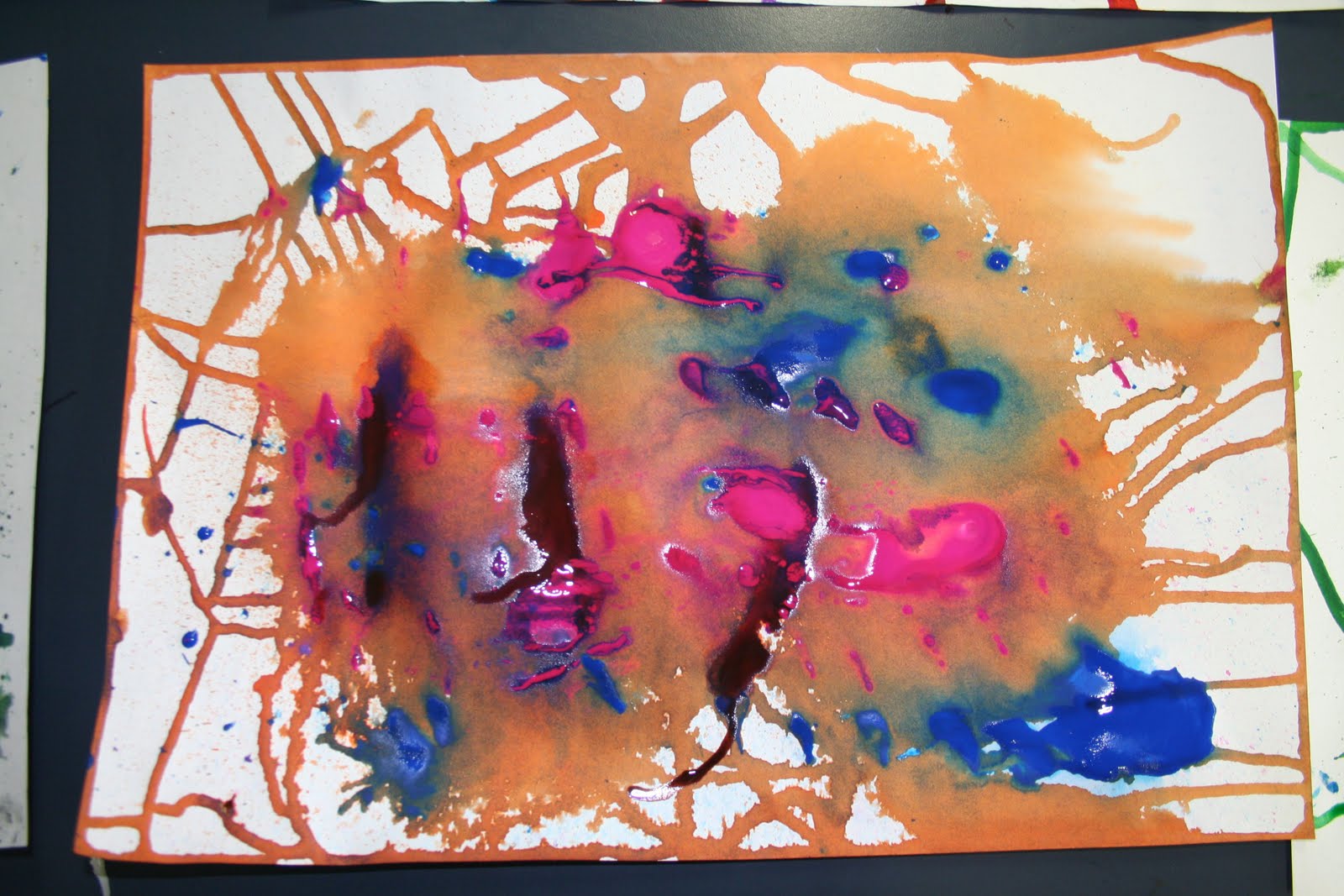
Just for fun, we changed tack completely and did abstract painting. This was a first for these children.
I thinned some acrylic paint and put out four different colours in containers, each with a spoon. Then I added a variety (colours) of containers with liquid dye to choose from.
The process is simple (but messy). Using wet strength cartridge paper you dribble two colours of paint around the paper then spray them with a water spray bottle. Next you dribble a dye colour and turn the paper up and around to spread the mix. Using a straw to blow the mixture also adds strange effects.
The first effort was a disaster! The children put too many colours on at once and discovered the age old problem, too many colours turns to mud. After some discussion it was decided to restrict the palette to 3 colours and spread the paint out around the page instead of putting it all in the centre. Great problem solving.
Watching the children observe the colours blending and forming patterns was magic. We decided next week (when the painting are finally dry) we will draw insects over the paint with indian ink. This is a lovely way of transferring knowledge.
It was interesting to note, the two best drawers in the class found this activity very difficult and the non academic children excelled in making patterns not mud.
In this photo the child drew what he thought was the object (left). The middle image is his attempt to draw the negative space, except he was not looking. (His brain was definitely in left hand mode). With a little time spent by me getting him to look from the middle of the object out and draw the space created in and around the object he succeeded (to his delight) See the right hand drawing; notice the direction the koru is going now, that was the correct way.
Indian ink and a wooden stick (kebab sticks) have become my best friend today. After pondering at great length on how to get these little cherubs to look carefully at the lines, shapes and detail of their drawing, I thought about indian ink. So I gave them detailed line drawings of insects to copy. To my delight the children looked carefully, drew with deliberate lines, added detail and came up with some fantastic images. (Yes! they can do it).
To top off the success I heard comments like, “ I never knew I could draw like this”. This is the best thing I have ever drawn”. “ Oh wow! The details are the same as the picture”.
Just for fun, we changed tack completely and did abstract painting. This was a first for these children.
I thinned some acrylic paint and put out four different colours in containers, each with a spoon. Then I added a variety (colours) of containers with liquid dye to choose from.
The process is simple (but messy). Using wet strength cartridge paper you dribble two colours of paint around the paper then spray them with a water spray bottle. Next you dribble a dye colour and turn the paper up and around to spread the mix. Using a straw to blow the mixture also adds strange effects.
The first effort was a disaster! The children put too many colours on at once and discovered the age old problem, too many colours turns to mud. After some discussion it was decided to restrict the palette to 3 colours and spread the paint out around the page instead of putting it all in the centre. Great problem solving.
Watching the children observe the colours blending and forming patterns was magic. We decided next week (when the painting are finally dry) we will draw insects over the paint with indian ink. This is a lovely way of transferring knowledge.
It was interesting to note, the two best drawers in the class found this activity very difficult and the non academic children excelled in making patterns not mud.
Subscribe to:
Comments (Atom)